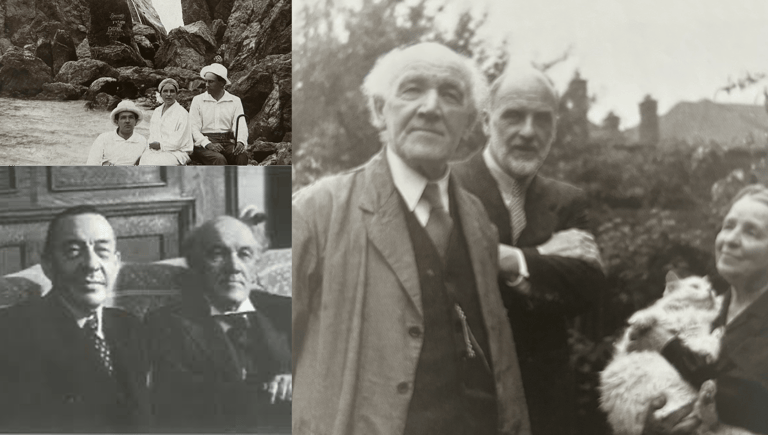
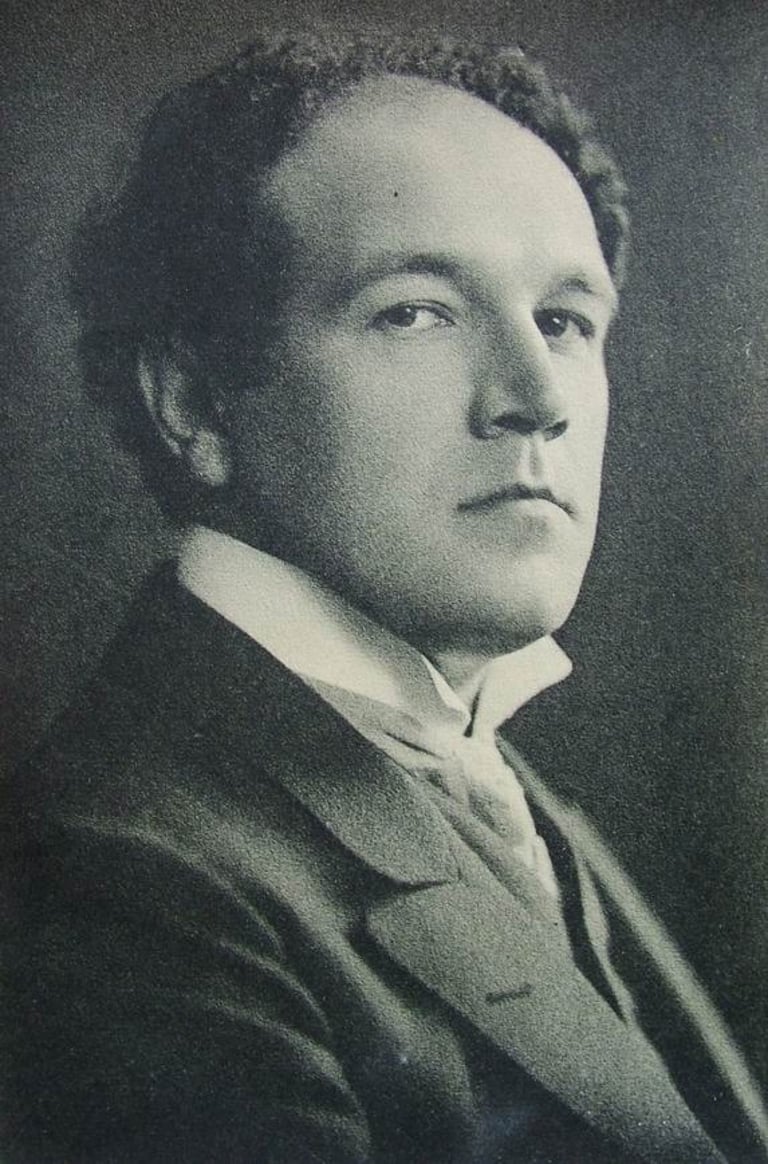
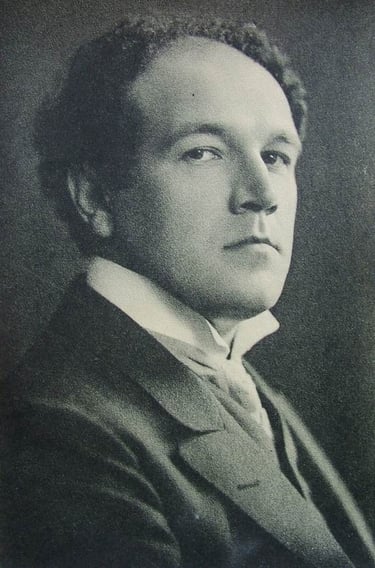
artist, but encouraged by Taneyev and his mentor in life, his eldest brother, Emil, he had a change of heart and decided that his true vocation after all was composition. Henceforth, devoting himself to his art with an almost religious zeal, he made no effort to build a career as a performer but treated his occasional concert appearances essentially as showcases for his own music, of which the bulk is for solo piano and none without a part for the instrument.
Medtner's professional career as a composer began in 1903 with the appearance in print of his first opus and the first public performances of his music. His Piano Sonata in F minor op.5 attracted the attention of the famous Polish virtuoso Josef Hofmann, and through him of Rachmaninoff, who in later years was to be a staunch friend and benefactor. Although the composer failed to make an impression on critics in Germany with performances of his music there in 1904–5 and 1907, in Russia, particularly in Moscow, he gradually built up a considerable following. There, his growing stature was recognized in 1909 by the award of the Glinka Prize for three groups of Goethe settings, by his appointment to the advisory board of the Editions Russes, and by the offer of a piano professorship at the Moscow Conservatory, which he held for one year only at this time but resumed during World War I. In 1916 he was again awarded the Glinka Prize, on this occasion for two piano sonatas (op.25 no.2 and op.27).
Medtner was unsympathetic to the Bolshevik Revolution, and in the autumn of 1921 he and his wife left Russia to begin a new life abroad. They settled first in Berlin, but at a time of intense musical experimentation there was little interest there in work in a traditional vein like Medtner's, and few engagements. However, Rachmaninoff helped out financially and organized an American tour for 1924–5, after which the composer moved to Paris, where his services disappointingly proved little more in demand than in Berlin and the artistic environment no more congenial. Outside a small Russian circle he had few friends, the most notable being Marcel Dupré, who, though a composer in a very different idiom, profoundly admired his colleague's music and playing, and was a great support to him throughout this difficult period. In February 1927 Medtner returned to his homeland for a concert tour lasting three months, and in 1928 paid his first two visits to Britain, in the course of which he was made an Honorary Member of the Royal Academy of Music and played his Second Concerto at a Royal Philharmonic Society concert. He was heartened by the enthusiastic reception and the apparent extent of his following in the country. For urgent financial reasons, in 1929–30 he undertook a second tour of North America, this time including Canada, but the cheque he received bounced, and he escaped insolvency only through the generous intervention of Rachmaninoff.
Deploring contemporary composing practice and the course of musical evolution over the previous three decades, in the early 1930s Medtner was at last spurred to write a treatise expounding his own conservative aesthetics. He made a declaration of faith in his treatise on what he saw as the eternal and immutable laws of art, and at the same time attacked both modernism and the vacant pursuit of current musical fashions as pernicious aberrations which, in his view, had destroyed the connection between the artist's soul and his art. His work was published in 1935 under the auspices of Rachmaninoff as Muza i moda (‘The muse and the fashion’).
Meanwhile, after further visits to Britain, where it seemed his best prospects lay, Medtner decided at last to settle in the country permanently. In October 1935 he and his wife moved into a house in Golders Green, London, their home for the next 16 years. The modest success the composer now began to enjoy was cut short by the outbreak of war in 1939, when concerts, the demand for lessons, and income from his German publisher all ceased. The Medtners now depended for their survival on the generosity of friends. With the blitz making work in London impossible, in September 1940 they gratefully accepted sanctuary in Warwickshire with the family of the pianist Edna Iles, throughout her career a champion of Medtner's cause. In Warwickshire in 1942, while writing his third and last concerto, the composer suffered a serious heart attack; however, he made a slow recovery and was able to give the first performance of the new work at the Royal Albert Hall in February 1944.
Though dogged by ill-health, Medtner's last years were brightened by an unexpected turn of events. In 1946 the Maharajah of Mysore sponsored the foundation of a Medtner Society, enabling the composer over the next four years to make gramophone recordings for EMI of many of his most important works, including the three concertos, the Piano Quintet, the First Violin Sonata, and many songs and solo piano pieces. These definitive performances constitute a priceless legacy of interpretative guidance.
Life
Legacy
As one of the very last Romantic composer-pianists, Medtner has a place in Russian music alongside his close contemporaries Skryabin and Rachmaninoff, whose careers overshadowed his own. Like them he made the piano the focus of his creative activity and possessed a total understanding of its expressive possibilities; his writing, though never virtuosic for its own sake, is often complex and highly demanding of the performer. In most aspects of musical style, however, his manner is quite distinct from theirs, for, unlike all but a few of his fellow countrymen, he tempered a Russian spirit with musical thought rooted firmly in the Western classical tradition, Beethoven in particular. This classical influence is to be seen in the composer's fastidious craftsmanship, his tight grasp of musical architecture, the frequent use of sonata form and his fondness for contrapuntal writing, of which he was a consummate master. Fully developed almost from the time of his first published works, his musical idiom changed very little throughout his career, and his entire output is remarkably consistent in quality.
Both the Russian and the German sides of Medtner's musical personality are apparent in his melodic construction, which ranges in style from the overt nationalism of the ‘Russian Tale’ to the hybrid lyricism of, say, the Second Concerto. These two aspects are most clearly distinguished in the songs, with settings of German poetry conspicuously lacking the often markedly Russian character of those in the composer's mother tongue, e.g. F.I. Tyutchev's Chto tï klonish′ nad vodami? (‘Willow, why for ever bending?’), or Pushkin's Telega zhizni (‘The Wagon of Life’).
In his harmonic language Medtner advanced but little beyond the boundaries set by 19th-century practice; in terms of rhythm, on the other hand, he was surprisingly progressive, particularly in his widespread use of elaborate cross-rhythms. An extreme example occurs in the Pushkin setting Elegiya (‘Elegy’) from op.45, where the vocal melody in common time has a piano accompaniment with two groups of five quavers in the right hand and two of triplet crotchets in the left.
Works
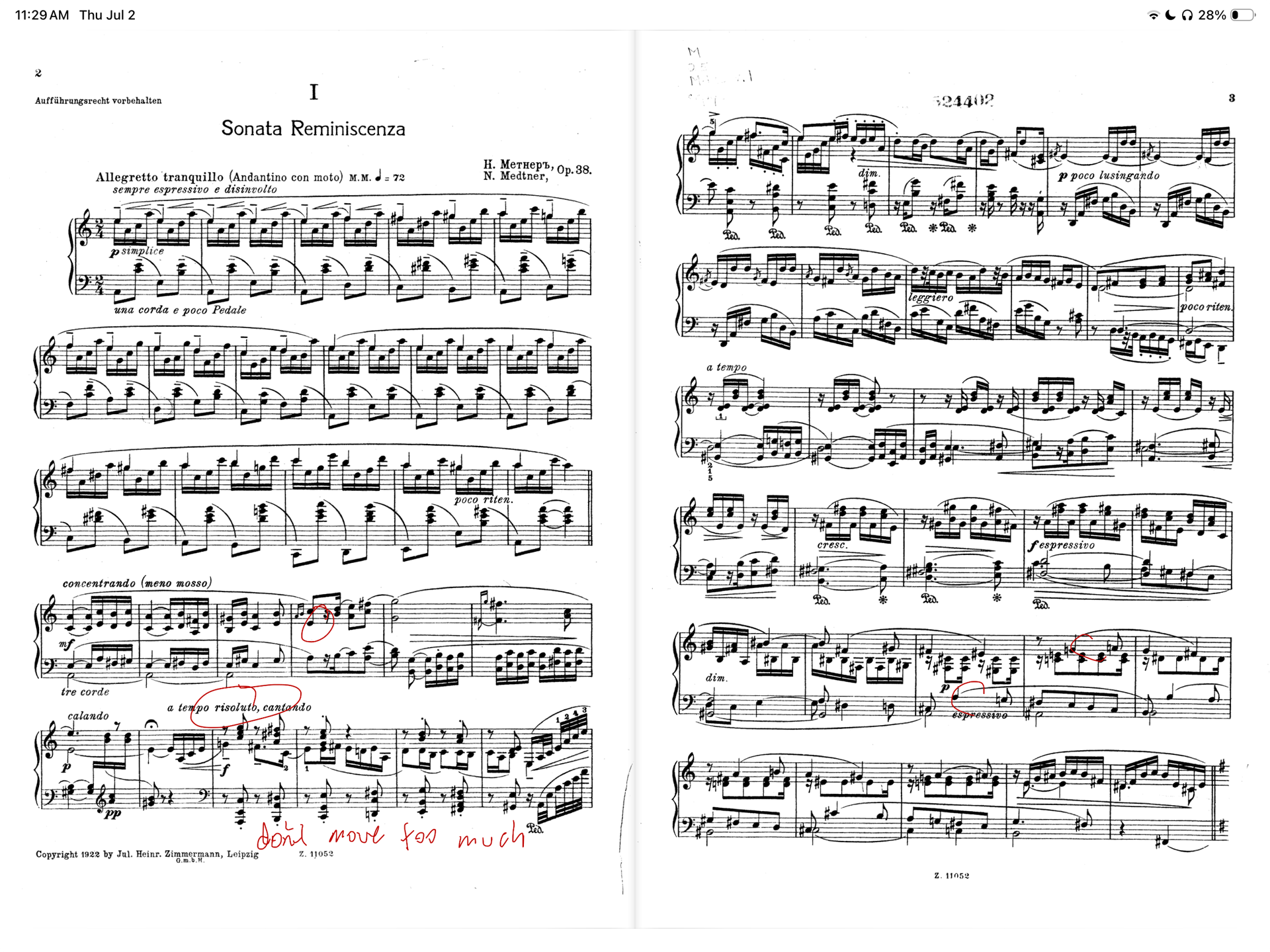
Spanning Medtner's output are 14 piano sonatas, a cycle to be set alongside those of Skryabin and Prokofiev as the most important Russian works in the genre. In scope they range from the brief single-movement works of the Sonaten-Triade to the epic Sonata in E Minor, op.25 no.2, which exemplifies at its finest Medtner's natural mastery of large-scale structure and fondness for thematic integration, and which some have claimed to be the finest piano sonata of the 20th century. Of the large body of miscellaneous piano music the 38 Märchen (‘Tales’), in Russian skazki (often, despite the absence of fairies in Russian folklore, misleadingly translated as ‘Fairy Tales’), widely varied in character and exquisitely wrought, are the composer's most significant and characteristic miniatures.
The three concertos, whose scale and resources allow the composer's thought its fullest expression, are the only works in which Medtner uses the orchestra. His writing for the violin, however, is idiomatic and eloquent, and the three sonatas for the instrument are among the most important in the Russian repertory. Together with two smaller sets of violin pieces and the Piano Quintet, they make up the whole of his chamber music.
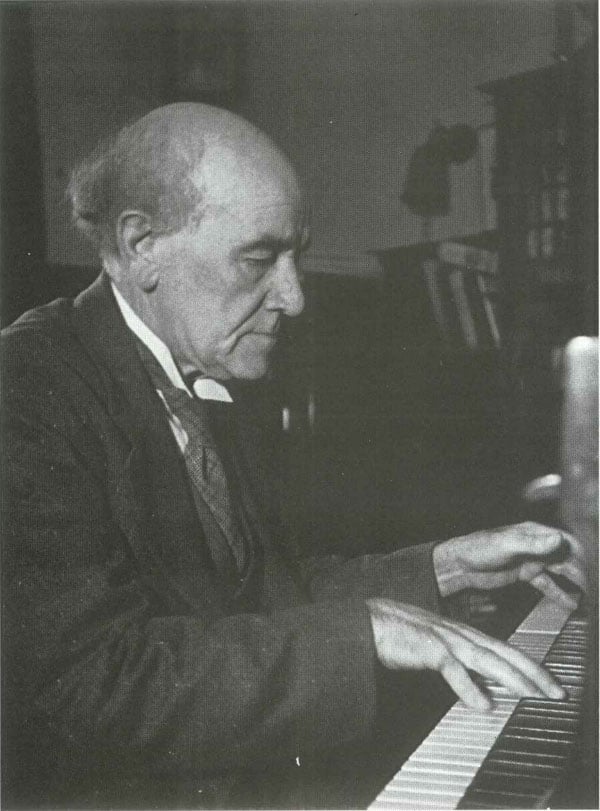
Of Medtner's 106 published songs, more than half are settings of Russian, the remainder of German, texts; Pushkin and Goethe predominate. It is perhaps from among the best of them, such as Pushkin's Muza (‘The Muse’), Elegiya (‘Elegy’), op.45, and Tyutchev's Bessonnitsa (‘Sleeplessness’), in which his strengths are seen in their most concentrated form, that the composer's finest work is to be found. Though some of the most successful settings have a very simple accompaniment (Pushkin's Roza (‘The Rose’), Goethe's Einsamkeit), in general the piano part has a musical role as important as that of the singer, and is often as complex and demanding as a solo piece (Pushkin's Zimniy vecher (‘Winter Evening’), Fet's Ya potryasen kogda krugom (‘O'er thee I bend’)). This approach to song writing as music for voice and piano on equal terms reached its logical conclusion in the Sonate-Vocalise and Suite-Vocalise for voice and piano, which, except for a motto from Goethe in the former, are sung entirely without words.